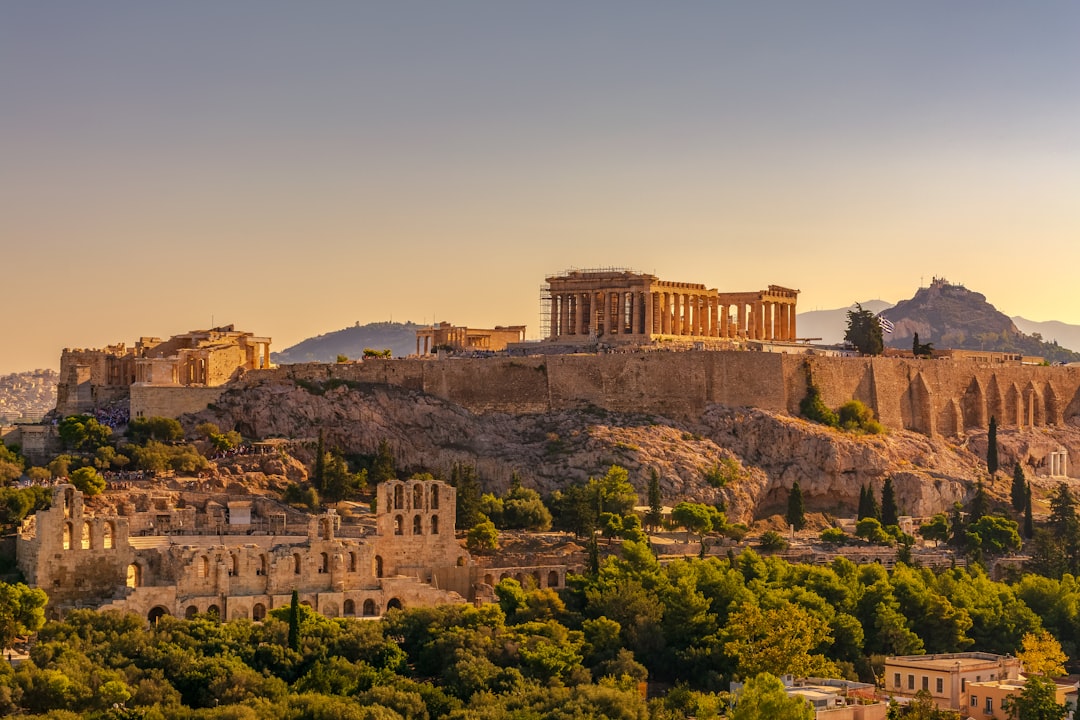
The Parthenon, then — the big one on the flat top of the rock. Find the middle of it, because the columns are doing perfectly well and it isn't them you want. It's the gap behind them.
The wind up here is constant, and the ground isn't soil, it's rock. You can feel the heat coming back up through your shoes. And there's a fine pale grit over everything, which is marble dust, because this hill has been a building site on and off for two and a half thousand years.
And there's a hole in the Parthenon. The colonnades stand, the ends stand, and the great room that used to sit inside them is gone. That absence is the single most important thing about this building, and it happened on one afternoon in sixteen eighty-seven.
Start with what it actually was, because it wasn't a cathedral. Athenians did not go inside to worship — the altar was out here, in the open, and the building behind it was a strongroom with a statue in it. The statue was Athena, about twelve metres tall, wood plated in
ivory and gold. That's something over a tonne of gold, a meaningful fraction of the wealth of the city. And Phidias, the sculptor running the whole project, had it made in removable plates so it could be taken off and weighed. He built the audit into the artwork, and they prosecuted him anyway.
Then the building started changing jobs.
Around the sixth century it became a Christian church, dedica