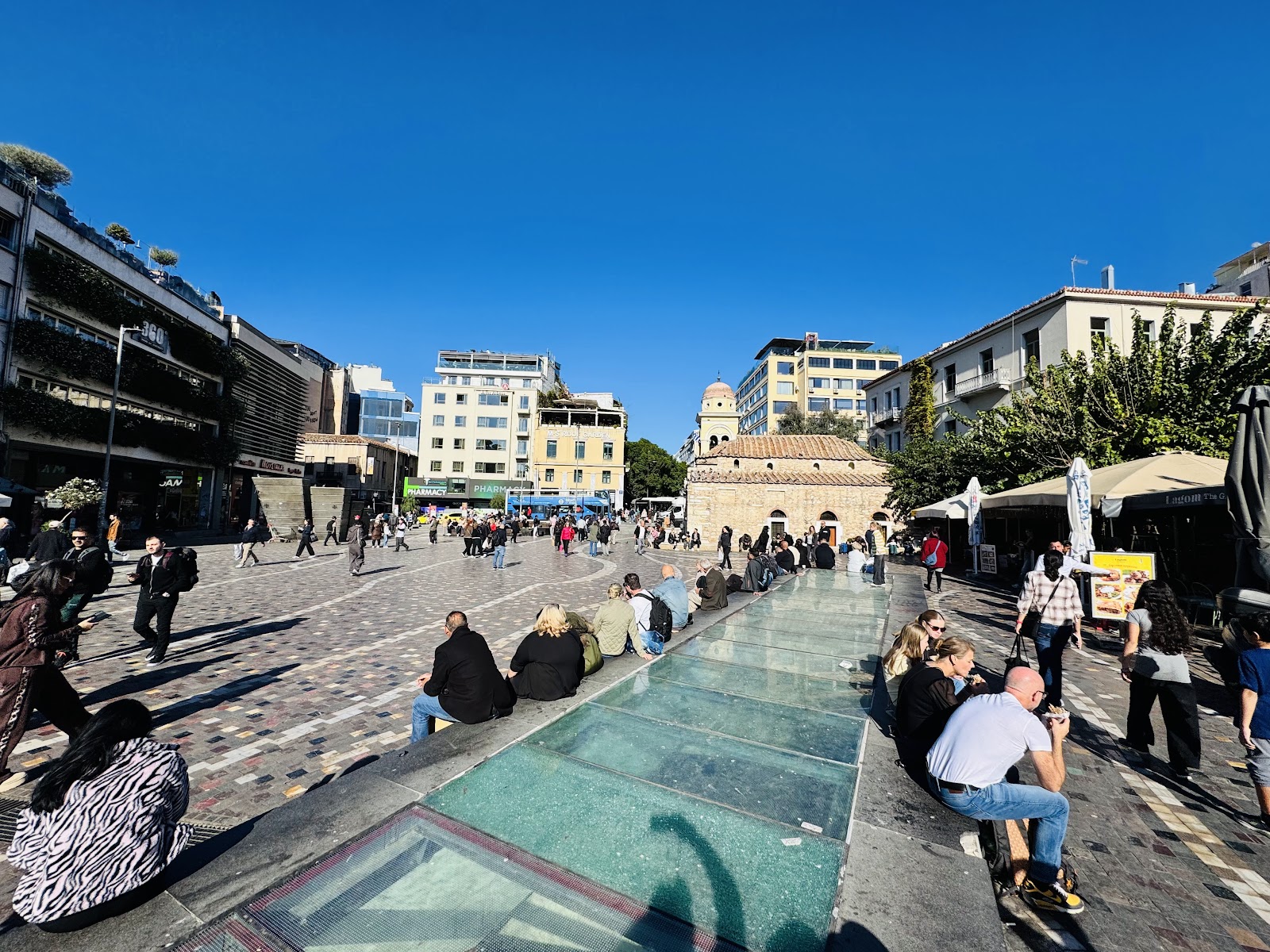
You can smell Monastiraki Square before you've finished crossing it. That's pork turning on a vertical spit, coming from a row of shops on the far side. They've spent about a century arguing with each other over who does it best.
Before the food, look down. There's an opening in the ground here, and underneath it runs the Eridanos. It's a small river the ancient Athenians walked beside, which Hadrian got tired of and roofed over with a brick vault in the second century, turning it into a sewer. It's still down there. Down in the metro station you can stand on a glass bridge and hear the water moving under your feet. Athens buried a river and never quite managed to get rid of it.
The food, then. Souvlaki is the most Greek thing you can eat standing up. Meat on a stick, or meat in a wrapped flatbread with tomato and onion and a fistful of chips shoved in. And the chips go INSIDE. That part isn't optional. Homer describes men skewering meat over a fire, so as ideas go it's about as old
as Greece itself.
The version being sold thirty metres from you, though, does not come down in an unbroken line from Homer. It was put back on the streets of Athens in nineteen twenty-four, by a man named Isaak Meraklidis.
Meraklidis was Armenian. He had fled Asia Minor two years earlier, in the catastrophe that emptied the Greek and Armenian towns of that coast. It sent something like a million