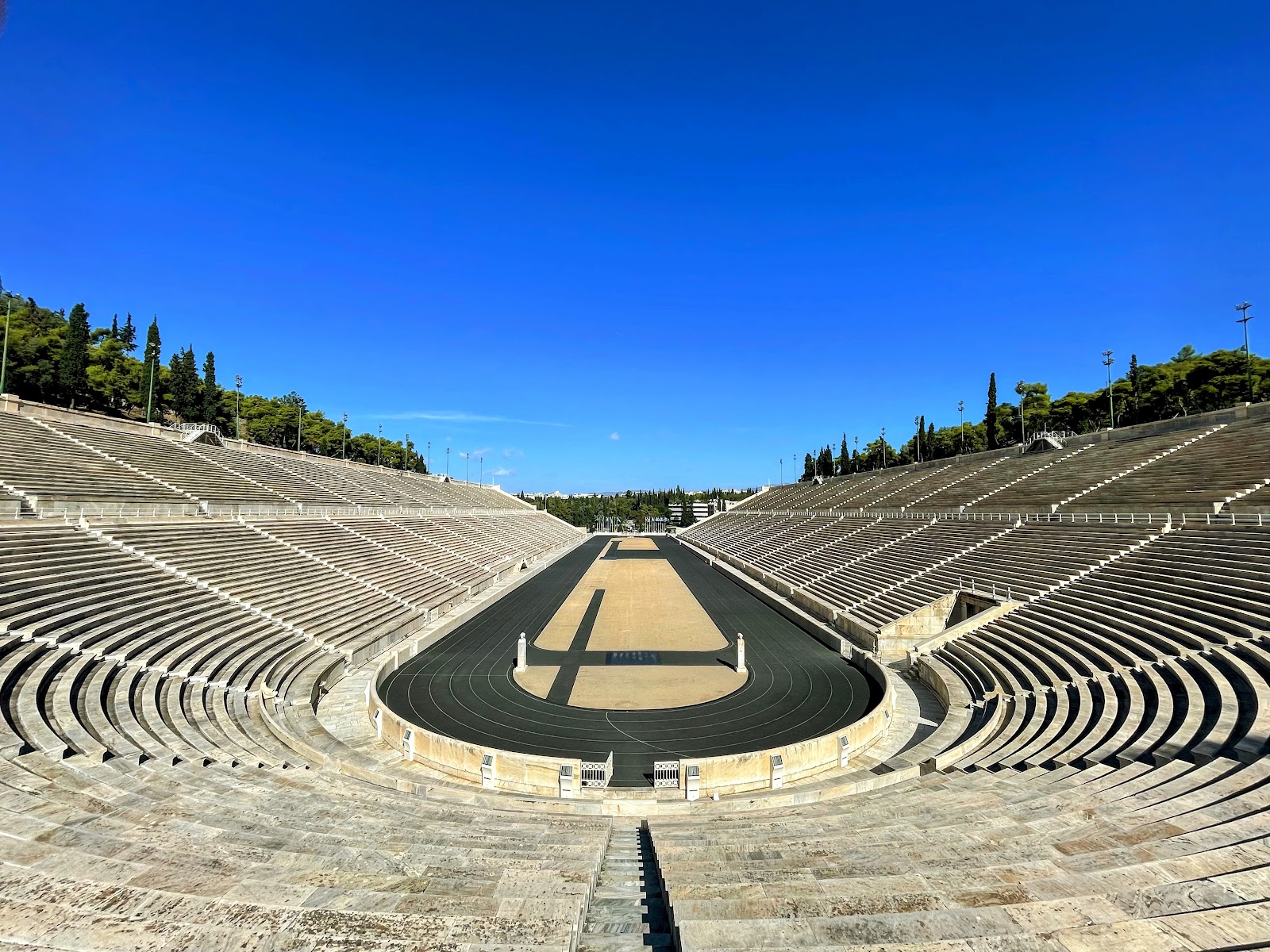
This is the Panathenaic Stadium, and whatever you're picturing when you hear the word stadium, this isn't it. The ends give it away — those turns are savagely tight, a long thin horseshoe with hairpins at the closed end, nothing like the wide ovals runners use now. Athletes at the first modern Olympics complained about it bitterly. Several of them lost time simply trying not to fall over on the corners.
It's that shape because the shape is ancient. There's been a stadium in this exact fold of ground since the fourth century before Christ. Then, around the year one hundred and forty-four, a spectacularly rich Athenian called Herodes Atticus rebuilt the whole thing in marble, with room for fifty thousand people.
Then Athens stopped needing it. The games ended, the seats came out, and the marble went into other buildings and into lime kilns. The hollow filled up with soil until it was a field with a dip in it. Which is what it was for well over a thousand years.
In eighteen sixty-nine
an architect dug it back out. And in the eighteen nineties, when Athens got the first modern Olympic Games, a Greek businessman in Egypt named George Averoff paid to rebuild the entire thing.
He had one condition, and it tells you what he thought he was funding. It had to be marble. Not concrete faced with marble — marble, all of it, from Mount Penteli, the same mountain the Parthenon came from.