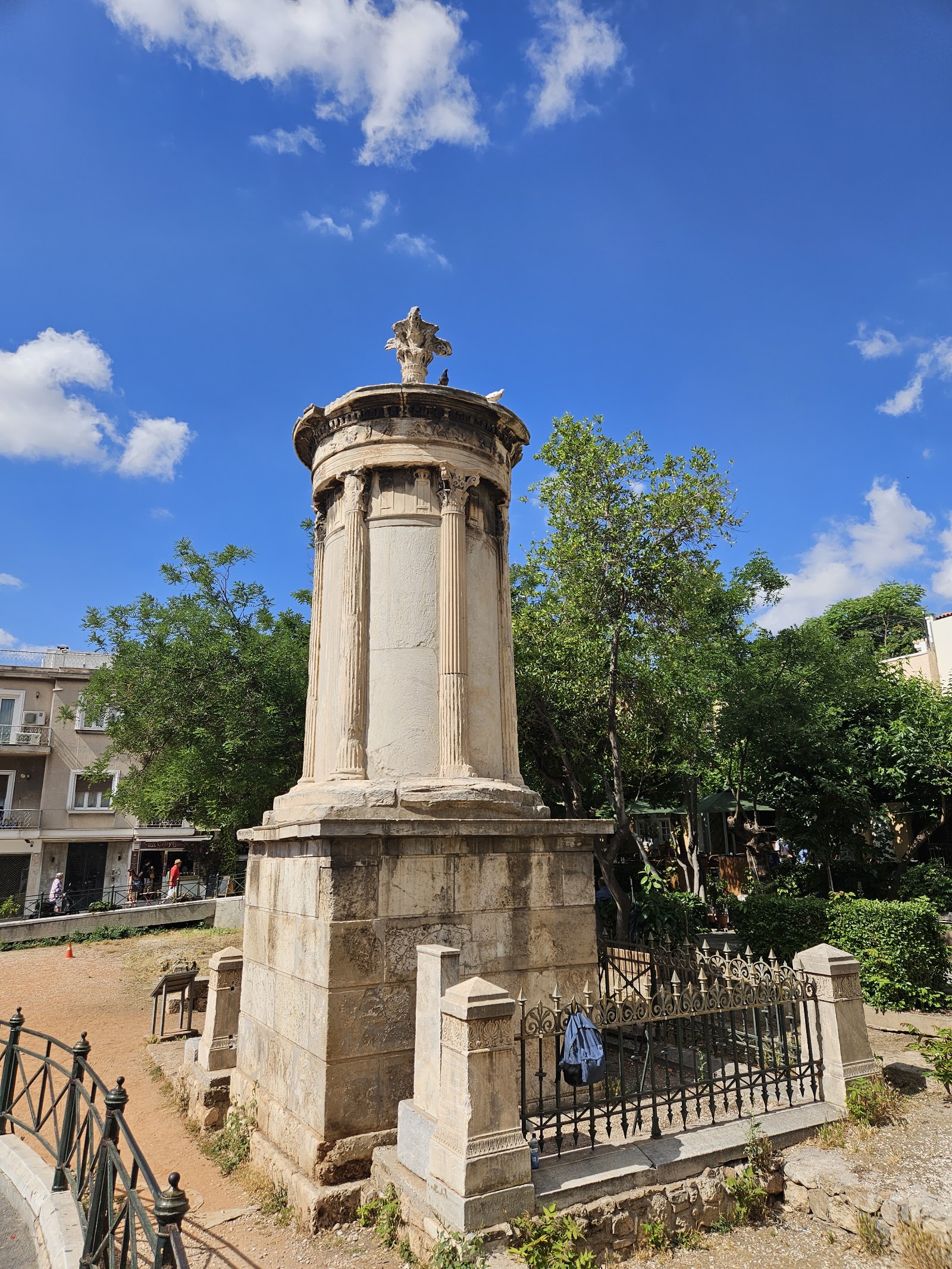
That little round marble drum standing on the square stone plinth is the Lysicrates Monument — say it lie-SIK-ruh-teez — and it's the smallest ancient thing in central Athens. It is also here for the least serious reason of anything you have looked at today.
It's a trophy stand for a singing competition.
Every spring, Athens held a drama and music festival, and one of the events was a choral competition. Massed choirs of fifty men or fifty boys, one from each tribe of the city, singing and dancing in a circle. The choirs didn't pay for themselves. A wealthy citizen was assigned to fund one, which meant paying for the training, the costumes, the flute player, and the months of rehearsal. That job was called being the choregos, and it was somewhere between a civic duty and a very expensive competitive sport.
In the spring of three hundred and thirty-four before Christ, a man named Lysicrates funded the winning boys' chorus.
The prize was a bronze tripod. And you could not simply take
a bronze tripod home and put it in the hall, because the whole point of winning was that everyone knew. So the sponsor built a monument in the street to hold the tripod up in the air where the city could see it. This is that monument, and the tripod sat up on the roof of it.
He was not the only one doing it. There was an entire road of these things, one victory monument after another, running fr