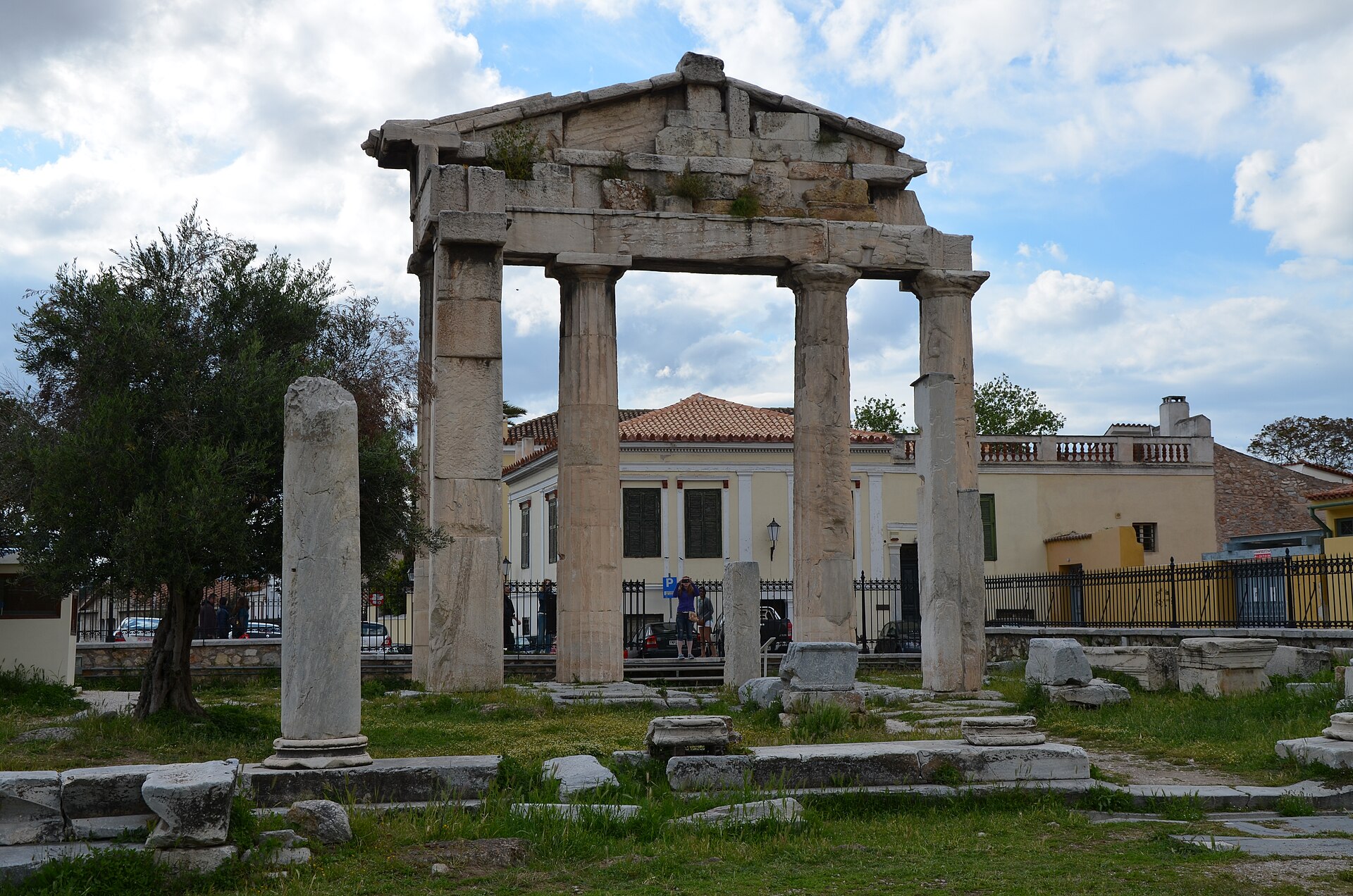
Four thick columns holding up a plain triangular top, with a fenced field of stones behind them — that's the Gate of Athena Archegetis, the front door of the Roman market of Athens. It went up around eleven years before Christ, and it was paid for by Julius Caesar and then by Augustus. Rome bought Athens a shopping centre.
Athens needed one. The old marketplace over the hill had spent four hundred years filling up with temples, law courts and monuments until there was barely room left to sell anything. The trade moved east onto fresh ground, and the money came from Rome — a conquering power buying commercial premises for the city it claimed to revere.
They did not do it quietly. The gate is dedicated to Athena the Leader, in Greek, on the front. Up on the top, above the goddess, stood a statue of Augustus's grandson. Rome paid for the door, credited the local deity at eye level, and put its own family on the roof.
Go to the right-hand side of the doorway, the upright block you'd bru
sh past walking through. There's writing cut into it. It's small, it's weathered, and it is an imperial decree about olive oil.
It was put there by Hadrian, the Roman emperor who spent his reign lavishing buildings on Athens, and it was added a century and a half after the gate itself. It sets out what oil producers owed the state — not as a suggestion, but as a schedule of obligations, listing w