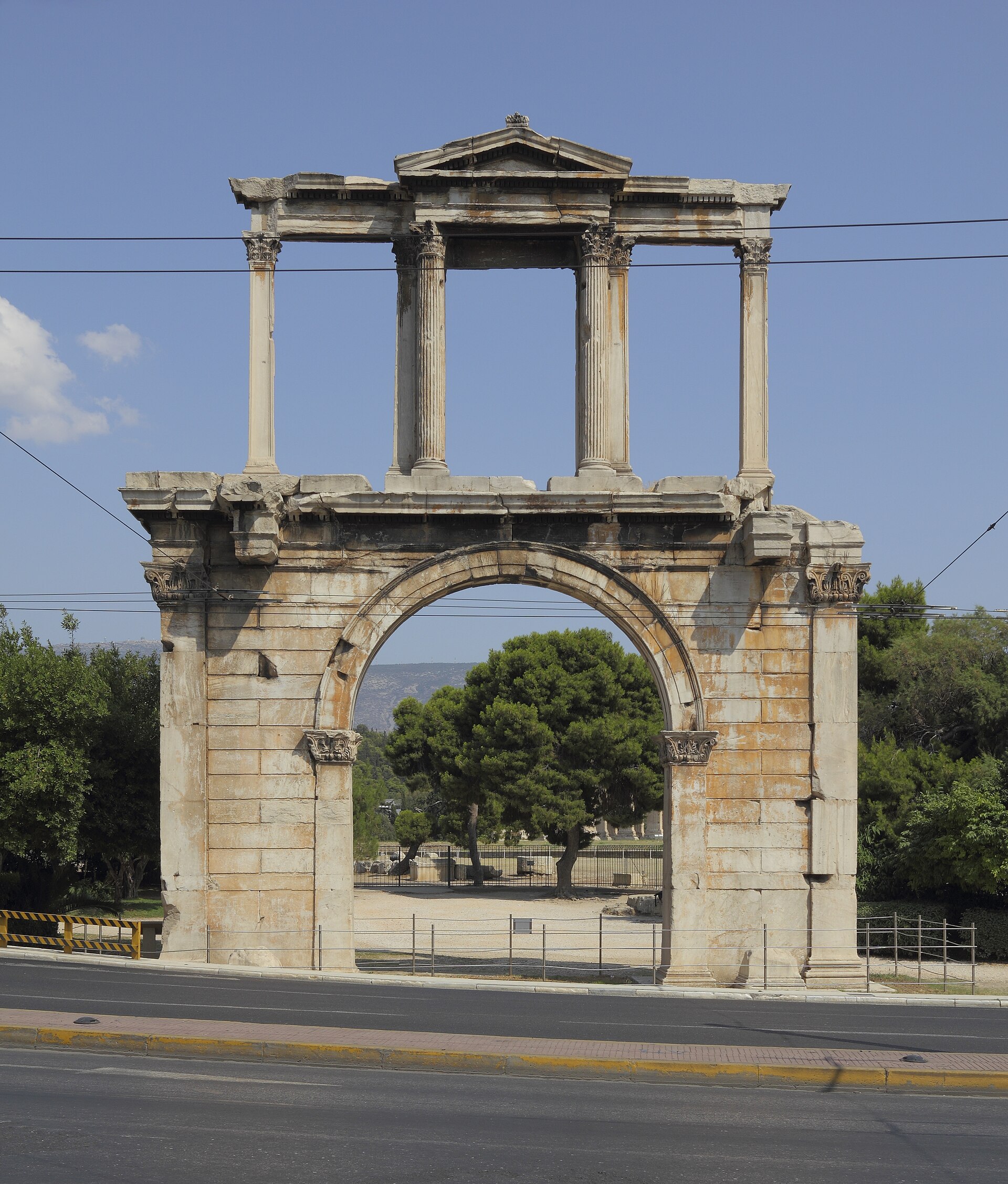
That freestanding gateway on the corner is the Arch of Hadrian. An arch is normally a hole you put in a wall, so look either side of this one, and you'll find there's no wall at all, and there never was.
Eighteen metres of Pentelic marble, gating absolutely nothing, put up around the year one hundred and thirty-one. It is also the only monument in Athens that argues with itself.
There's an inscription cut across it, above the opening. On the face pointing back the way you came, toward the Acropolis, it reads: this is Athens, the ancient city of Theseus.
Now walk under it, come out the other side, and turn round. Same arch, same band of stone, same afternoon's work. And that one reads: this is the city of Hadrian, and not of Theseus.
The thickness of one arch apart. One side hands the city to a mythical founder-king. The other takes it off him and gives it to a Roman emperor who was, at that moment, alive and in town.
And the thing Theseus gets credited with is not a small one. In
the legend he is the man who took the scattered towns of the countryside and talked them into being one city, which is the moment Athens becomes Athens at all. So both faces of that stone are making the same kind of claim, about who made the place.
The two texts aren't cut by the same hand, either. The Hadrian side is shallower and slightly more crowded at the end of the line, like the mason was