Catedral de Mallorca

Catedral de Mallorca

Mallorca, Spain

La Seu. The cathedral. Get close to the stone, because it's the colour of sand and full of shell fragments — it was quarried out of this island's own seabed, and in low sun the whole building goes gold.

Inside this cathedral there are two objects that Mallorca has been arguing about for a hundred years, and neither of them was supposed to be permanent.

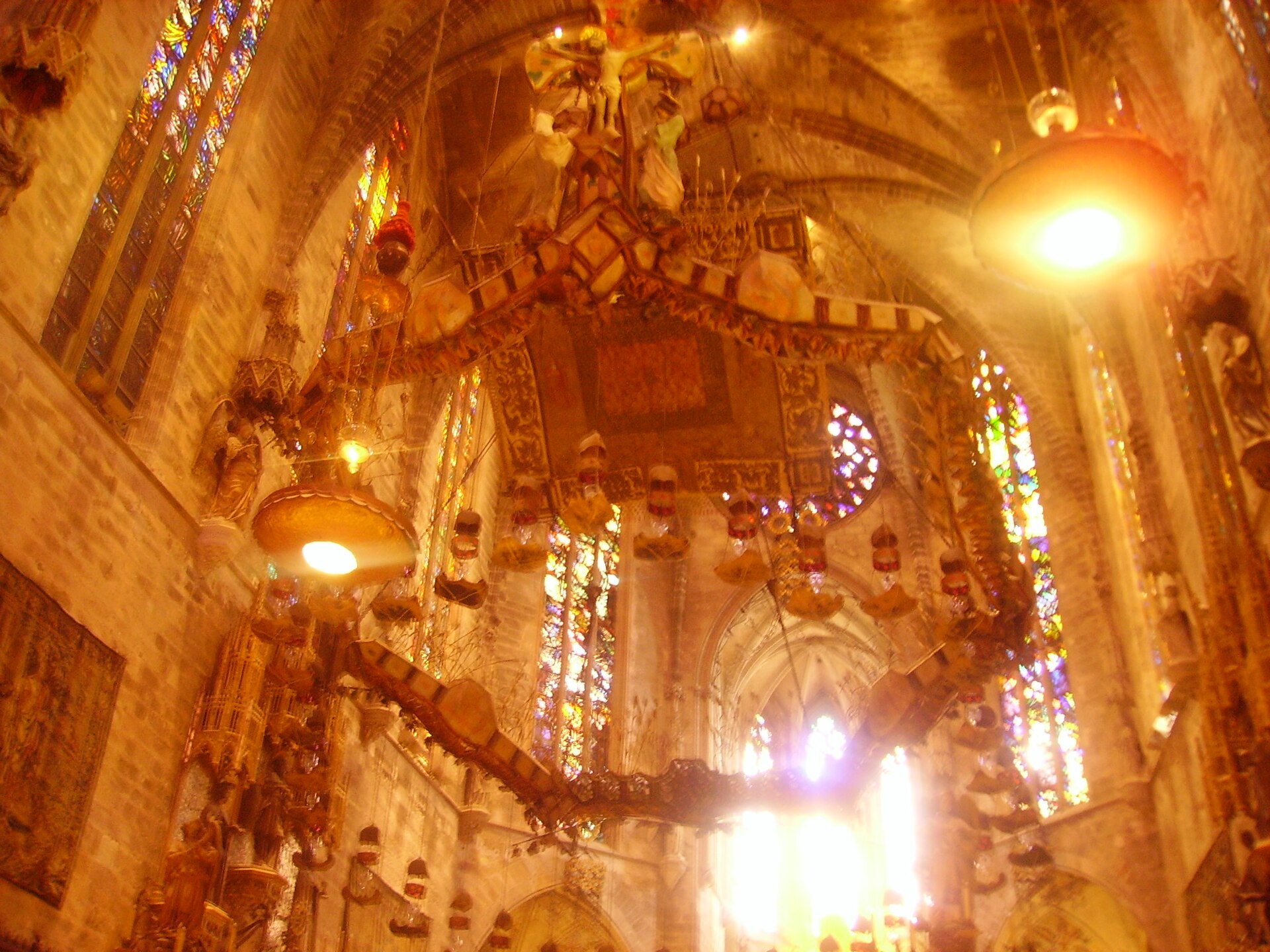
Start with the ceiling above the high altar. There's an enormous thing suspended up there — a great heptagonal canopy, wrought iron and glass and gilding, a crown of thorns with a crucified Christ hanging inside it, and the Virgin and Saint John at the foot. It hangs on cables. Nothing holds it from below.

Antoni Gaudí made that. And it is a model.

The bishop brought Gaudí over in nineteen oh-four with a specific complaint: the cathedral was gloomy and the congregation couldn't see anything, because a huge stone choir sat in the middle of the nave blocking the view. Gaudí's answer was to take the choir out and move it, open up windows that had been bricked in for centuries, and light the whole interior — dozens of iron lamps, all his design.

Understand what removing that choir meant. It was a walled enclosure of carved stone and tim

ber, centuries old, sitting in the middle of the church like a building inside a building, and it was where the clergy sat. Taking it out means telling a cathedral chapter that the furniture their predecessors installed is in the way, and then physically dismantling it and putting it somewhere else. He also unblocked windows that generations had deliberately filled in. This was not restoration. It
Hear the full story

Hear this story with audio narration in the Bad Historian app.

Get the App

Quick Facts

  • By tradition, Jaume the First vowed to build a church to the Virgin during a storm on the crossing to Mallorca; the foundation stone was laid on the site of the city's main mosque.
  • Construction ran roughly three hundred and seventy years, and the cathedral was declared finished in sixteen oh-one.
  • The nave is forty-four metres high, among the tallest Gothic naves in Europe.
  • An earthquake in eighteen fifty-one destroyed the west front; the architect Juan Bautista Peyronnet demolished the remains and rebuilt it in neo-Gothic style, leaving only one original doorway.
  • The rose window is the largest in the Gothic world, and twice a year — in February and November — sunlight through it projects a second rose window onto the opposite wall, forming a figure eight.
  • Antoni Gaudí worked on Palma cathedral from nineteen oh-four to nineteen fourteen, invited by Bishop Campins to bring light into the building.
  • He removed the stone choir from the middle of the nave, reopened windows that had been bricked up for centuries, and designed dozens of iron lamps.
  • The great canopy hanging over the high altar is a full-size mock-up, intended to be replaced by a permanent version, and it has hung there for more than a century.
  • Gaudí abandoned the project in nineteen fourteen after the death of Bishop Campins and a dispute with the contractor, and never returned.
  • Between two thousand and one and two thousand and six, Miquel Barceló covered three hundred square metres of a chapel apse in modelled ceramic showing the loaves and the fishes.
  • Barceló's chapel caused a public row over both the intervention and his fee, and was inaugurated in February two thousand and seven.
Featured Tour

Everyone Wanted This Island

12 stops • 1h 15m

View Tour

Location

Mallorca, Spain
Open in Maps